
Using eye tracking in virtual and digital environments to estimate and adapt to a user’s stress, workload, and fatigue levels.
Stress and performance are closely intertwined. In the right measure, pressure can sharpen attention, increase motivation and help people perform at their best. Too little, and performance suffers through boredom or disengagement. Too much, and stress tips into anxiety, disrupting focus, decision-making and efficiency.
This balance is often described as a ‘Goldilocks zone’, a point where challenge and capability are well matched. It is a concept that has been explored for decades across psychology and human-performance science. Yet in most digital and training environments today, this balance is still largely guessed at rather than measured.
The question is no longer whether stress affects performance, but how we can recognise when someone is moving out of that optimal zone and what we can do about it in real time.
Estimating cognitive state with eye‑tracking
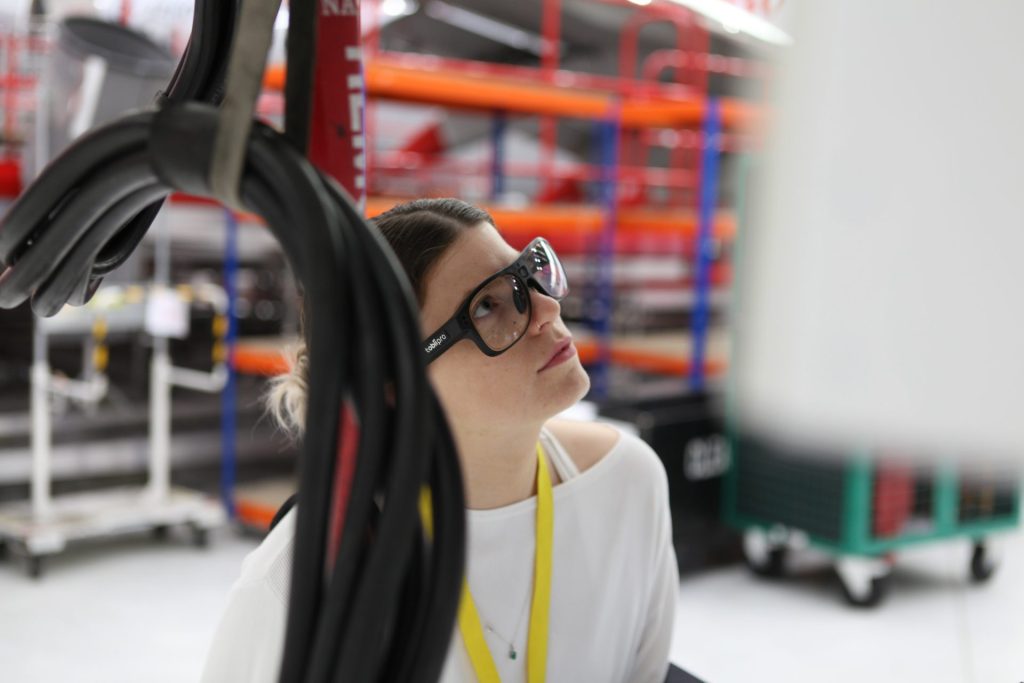
We can infer someone’s stress, workload, and fatigue levels, without asking them directly, leveraging technology that can track a user’s visual attention. This is because cognitive state affects how the eyes behave.
Eye-tracking technology provides a passive method to infer someone’s internal state. Changes in fixation duration, increased saccades, and less efficient gaze behaviour often signal elevated stress. These indicators are consistent across a range of contexts, from sports performance to pilot training.
Cineon’s research and development teams have leveraged these patterns to train machine-learning models that estimate stress, workload and fatigue levels through eye-tracking in virtual and real-world environments. This capability forms the backbone of Cineon’s emotionally intelligent systems.
ELE: Cineon’s Empathic Learning Engine
To provide accurate estimates of stress, workload, and fatigue across a range of contexts, our data‑science team create and validate AI machine‑learning models using data collected by our research team. We call the suite of models, the API used to access them, and the dashboard used to view them, ELE: the Empathic Learning Engine.
Our approach for establishing ground truth is simple and evidence based. Subjective perception measured through self‑report is the basis of our ground truth. The outputs of these models are made accessible through the ELE Dashboard, a visual-analytics interface designed to transform complex behavioural and physiological data into clear, interpretable insights.
Cineon are combining the estimation of stress, workload, and fatigue with an adaptation engine, enabling a virtual or digital system to not only intuit the emotional state of the user, but to make changes to the environment to suit their state of mind.
The updated white paper explores the science and application of ELE in detail.


