

How Cineon’s Technology Understands People in Real Time
Behavioural AI is changing how technology understands and supports people.
At Cineon, we have spent years building our behavioural AI system that operates in real time, in immersive and real-world environments where human performance truly matters. We are pioneers in the use of eye tracking as a core signal to enable behavioural AI, allowing digital systems to understand not just what users do, but how they think and feel as they do it.
This is not intelligence built around tasks or outcomes alone. It is intelligence built around people.
What Is Behavioural AI?
Behavioural AI is artificial intelligence that understands people by analysing how they behave in real time.
Rather than relying on static data such as images, text, or post-task feedback, behavioural AI interprets dynamic human signals including eye movements, pupil dilation, physiology, and interaction patterns. These signals reveal how attention, stress, workload, and fatigue influence performance moment by moment.
The result is an intelligent system that can estimate a user’s psychological state and responds to it in real time, adapting experiences as they unfold rather than after the fact.
This shift from retrospective analysis to real-time understanding is what makes behavioural AI fundamentally different.
Cineon’s Behavioural AI System: ELE
Cineon’s Empathic Learning Engine (ELE) is our proprietary behavioural AI architecture, powering the only API that turns eye‑tracking and movement data into objective measures of cognition, emotion and performance.
By focusing on behaviour rather than identity, ELE enables intelligent adaptation across immersive experiences and real‑world applications, without relying on intrusive or personally identifiable data.
Designed with safety, privacy, and human capability at its core, the ELE API enables teams to:
- Measure stress, workload, and fatigue in real time
- Personalise training and digital experiences to the individual
- Gain deep insight into human performance without intrusive data capture
This approach allows systems to respond to people as they are, not as an average user model assumes they should be.
To demonstrate ELE in action, we created Balloon Pop, a VR minigame where players shoot balloons, but only some are valid targets. While the task feels simple, ELE tracks eye behaviour behind the scenes to estimate stress and cognitive load. As the task becomes easier or more challenging, the system dynamically adjusts difficulty to keep the player within their optimal performance zone.
How Behavioural AI Works
Behavioural AI operates as a continuous, real-time cycle rather than a linear process.
Step 1: Observation
Behavioural and physiological signals such as eye and head movements, pupil dilation, blinks, reaction times, and interaction patterns are captured to understand how attention, stress, and workload influence decision-making.
Step 2: Analysis
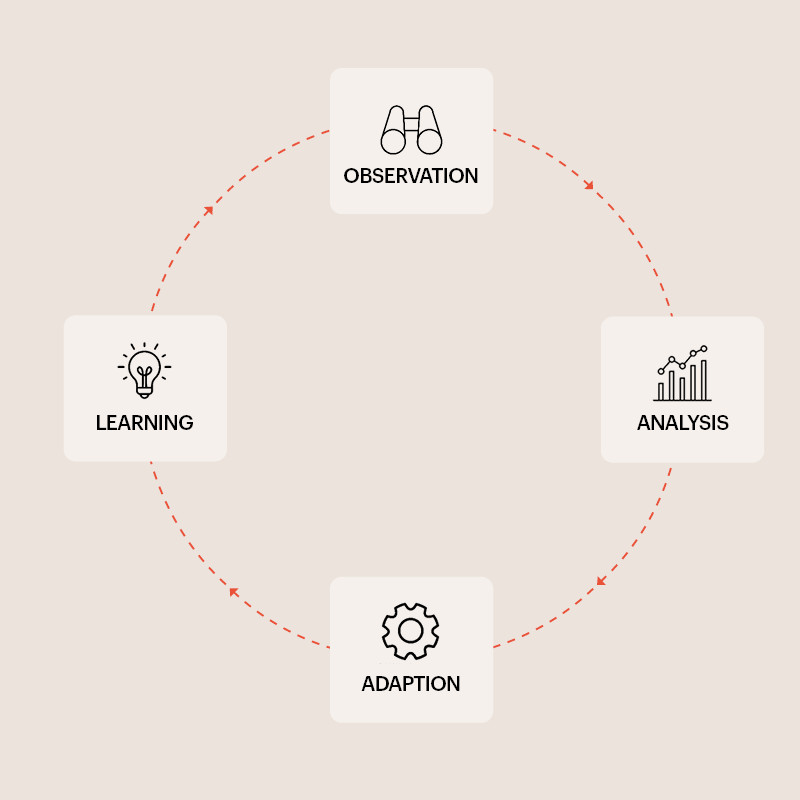
Machine learning models analyse these signals to identify patterns and indicators of cognitive and emotional state. These models detect subtle cues that are difficult to identify manually, enabling objective insight into performance.
Step 3: Adaptation
The system responds by dynamically adjusting the environment. This may include changing task difficulty, pacing, visual complexity, or guidance to support focus and reduce unnecessary stress in real time.
Step 4: Continuous Learning
With each interaction, the system refines its models and adaptation strategies. This enables increasingly accurate personalisation while maintaining ethical data use and user trust.
Behavioural AI in Action: ELE and Balloon Pop
Balloon Pop demonstrates how ELE moves through the behavioural AI cycle in practice.
Step 1: Observation
ELE monitors eye movements, reaction times, successful hits, misses, and behaviour under pressure.
Step 2: Analysis
Monitors player workload and error rate.
Step 3: Adaptation
Responds dynamically. Balloons slow down during moments of stress and speed up when the player is fully engaged.
Step 4: Continuous Learning
ELE refines difficulty and personalisation over time, keeping data anonymous and secure.
Ethics and Privacy by Design
Because behavioural AI works with signals linked to cognition and emotion, ethical design is essential. Responsible behavioural AI systems must:
- Seek informed consent
- Collect only what is necessary
- Keep data anonymous
- Maintain strong security
- Clearly explain how and why adaptations occur
Unlike facial recognition systems, which identify individuals using biometric markers, behavioural AI focuses on state, not identity. ELE does not need to know who a user is. It tracks behavioural patterns over time to support performance, wellbeing, and learning.
In short, behavioural AI enhances experiences. It does not track identity.
Real-World Applications of Behavioural AI at Cineon
At Cineon, behavioural AI is not a concept. It is embedded in products used in real-world, high-stakes environments.
- TACET: Mixed reality training and assessment software for the aviation industry. TACET delivers immersive, cost-effective training environments that develop skills such as workload management, decision-making, and situational awareness.
- TACET-Walkaround: A CAA‑approved VR aircraft walkaround trainer used by Jet2.com pilots to deliver repeatable, data‑driven pre‑flight inspection training aligned with modern competency frameworks.
- iSAVE: A virtual MRI experience that helps patients prepare for scans. The system adapts in real time to anxiety levels, enabling personalised exposure therapy and improved patient outcomes.
- RCAT: Immersive VR training for room clearance and close-quarter operations. Developed in collaboration with the University of Exeter, RCAT uses eye-tracking-enabled virtual reality to explore adaptive, personalised training that improves performance while reducing risk.
These examples show that behavioural AI does more than collect data. It improves outcomes, reduces stress, and supports human performance where it matters most.
The Future of Behavioural AI
Behavioural AI represents a human-centric future for technology.
Instead of forcing people to adapt to rigid systems, behavioural AI enables systems to adapt to people. By combining behavioural science, real-time signals, and AI, we can build digital environments that understand and support human performance in the moment.
At Cineon, we believe behavioural AI will become a cornerstone of next-generation immersive and real-world systems. Not as an add-on, but as the core intelligence that allows technology to work with human complexity rather than against it.
This is psychologically intelligent technology, with humans firmly in the loop.
Want to see what behavioural AI could do for you? Connect with one of our experts today.


