

Developing digital mental health technology is about much more than building innovative software.
Over the past several months, Cineon has worked alongside Torbay and South Devon NHS Foundation Trust and the University of Bath to develop ELE-Stress, an immersive stress management platform designed to help frontline workers better understand and manage workplace stress.
Supported by Innovate UK’s Mindset XR programme, the project explored how virtual reality, behavioural science and adaptive technologies could be combined to make evidence-based stress management support more accessible and engaging.
As development progressed, we discovered that some of the most valuable insights had little to do with the technology itself. Instead, they centred on users, trust, implementation and what it really takes to create a digital wellbeing solution that can work in the real world.



1. Start with the problem, not the technology
Technology can be exciting, but it should never be the starting point.
Throughout the project, we continually challenged ourselves to focus on the real problem we were trying to solve: helping people in high-pressure roles access practical support for managing stress.
This meant looking beyond technical capabilities and asking a simple question: does this genuinely help the user?
One of our biggest lessons was that successful digital wellbeing solutions are built around user needs, not around the latest technology.
2. PPIE should shape development, not validate it
The research and clinical team at the University of Bath ran the Patient and Public Involvement and Engagement (PPIE) throughout the project, which played a vital role.
In technology development, it’s easy to focus on what is technically possible. PPIE helped us focus on what matters most to the people who may ultimately use the platform.
Participants raised important questions around trust, privacy, acceptability and how the technology would fit into real-world environments. These insights challenged assumptions and influenced design decisions in ways that would not have emerged from a purely technical or research-led perspective.
One of the key lessons from ELE-Stress is that PPIE should not be treated as a final checkpoint for validating a product. It should help shape the product from the beginning, influencing not just how a solution works, but whether it solves the right problem in the first place.
3. Trust matters as much as accuracy
When developing technologies that interact with wellbeing and mental health, trust is essential.
The project highlighted the importance of transparency around what information is collected, why it is collected and how it is used.
For example, there can be a fine line between technology that feels supportive and technology that feels intrusive. Even a highly accurate system can struggle to gain acceptance if users do not understand or trust its purpose.
Building trust is not simply a communication challenge. It is a product design challenge.
4. Just because we can measure something doesn’t mean we should
ELE-Stress explored whether behavioural signals, including eye-tracking data, could help personalise the user experience and support stress management.
Along the way, we learned an important lesson: not every piece of information that can be collected needs to be collected.
Every additional data source brings new considerations around privacy, governance, implementation and user acceptance.
Rather than asking how much information can be gathered, a better question is: what is the minimum information needed to provide meaningful support?
This principle became an important guide throughout the project and remains central to the responsible development of AI-enabled wellbeing technologies.
5. Virtual reality is a delivery tool, not the intervention
One of the key insights from the project was that virtual reality should be viewed as a means of delivering support rather than the support itself.
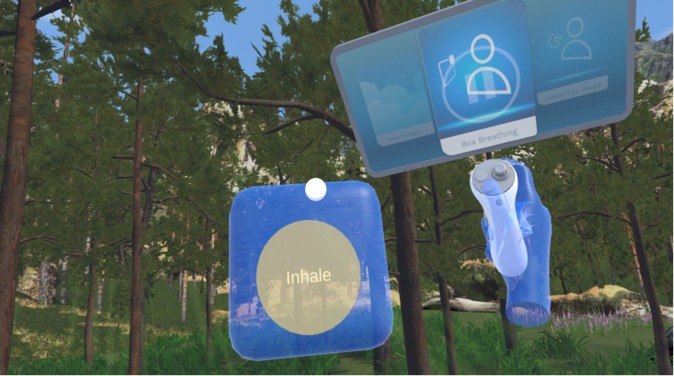
ELE-Stress uses immersive environments to help users learn and practise evidence-based stress management techniques, including breathing exercises, mindfulness and reflection activities.
The effectiveness of the experience depends far more on the quality of those techniques than on the complexity of the virtual environment.
A highly detailed virtual world is not automatically more effective. What matters is whether the experience helps users engage with and apply skills that can improve their wellbeing.
6. Deployment begins long before launch
A solution that works perfectly in a research environment may face very different challenges in the real world.
Questions around accessibility, hardware management, session length, user support and organisational workflows all influence whether a product can be adopted successfully.
The project reinforced the importance of considering these practical factors early in development, rather than treating them as questions to answer after the technology has been built.
Thinking about deployment from the outset helped us move beyond creating a technology demonstrator and towards designing a solution that could fit into real workplace settings.
7. Digital mental health products are systems, not apps
Perhaps the biggest lesson from the project was a shift in perspective.
At the start of development, it was easy to think about ELE-Stress as a virtual reality application supported by AI. Over time, it became clear that it was part of a much wider system.
Successful digital mental health solutions sit at the intersection of technology, psychology, user experience, governance, evidence and implementation. Each of these elements influences the others.
A technically impressive product alone is not enough. Success depends on whether the complete system can operate safely, effectively and usefully within the environment it is designed to support.
A Collaborative Effort
ELE-Stress has been developed through a close collaboration between Cineon, Torbay and South Devon NHS Foundation Trust, and the University of Bath. Bringing together expertise from behavioural science, healthcare, immersive technology and AI has been critical in ensuring the platform is both evidence-based and practical for real-world use.
We would like to thank Dr Caitlin Naylor, Dr Rachel Arnold, Dr Jo Daniels, Dr Nick Peres and the Torbay Digital Futures Lab team for their invaluable contributions throughout the project.
Looking ahead
The completion of the development phase marks an important milestone for ELE-Stress, but it is not the end of the learning journey.
As the project moves into user testing, we look forward to understanding how frontline workers engage with the platform and what further improvements can be made.
What ELE-Stress has already shown is that successful digital wellbeing technologies require more than innovation alone. They require thoughtful design, scientific evidence, responsible use of data and a clear focus on the people they are intended to support.
Ultimately, the most important lesson from the project is a simple one: technology does not improve wellbeing on its own. Meaningful impact comes from understanding people first and designing solutions around their needs.


